 2 months ago
67
2 months ago
67
There's always a touch of intrigue when Eugene Lee pulls out one of his fountain pens.
Whether it’s puzzled whispers of “what’s that?” from distributors or nicknames like “the big red pen” from bemused colleagues, the 47-year-old semi-retired businessman relishes these quiet moments of standing out.
Fountain pens may be unfamiliar to those around him, but for Lee, they’re an obsession – he has a personal collection of more than 100 pens and ink bottles worth over S$50,000.
These pens are not your typical and easily accessible models from stores such as Kinokuniya or Popular. His collection mainly comprises rare and one-of-a-kind pens from Japanese pen manufacturers like Platinum, Pilot and Sailor, sourced from a local seller, with each pen averaging between S$500 to S$1,000. Most are fitted with a 14, 18 or 21 Karat gold nib, which is the metal writing tip of the pen.
“I tend to go for brands that are established but not so well known in my circle; you can tell it is not a S$3 G2 gel pen from Popular, but you don't exactly know what it is,” Lee told CNA Lifestyle. “So there's still that little bit of air and mystery about it.”
“It also has that feel good factor,” he shared, noting that in the past, some prospective business partners even judged whether to work with him by the pen he used.
Exquisite yet unassuming, it’s a collection not meant to be flaunted – no dedicated social media page or any membership in pen communities – just quietly grown, stowed away in drawers and locked in cabinets.
THE UNMATCHED WRITING EXPERIENCE
Like many, Lee started with simple, inexpensive gel pens, favouring rollerball ones as they were “easy to use and less messy”. But as he and his wife cycled through pens regularly at work, the amount of plastic waste quickly accumulated.
He soon made the switch after eventually learning about fountain pens, including their use of bottled ink over disposable cartridges.
“You could fill one fountain pen with a bottle of ink many, many times, and you will generate far less waste than you would if you use a box of rollerball gel pens,” Lee told CNA Lifestyle when we visited him at home.
In 2019, his wife bought him his very first fountain pen – the Graf von Faber-Castell pen made of sterling silver and wood. Lee was drawn to the exceptional writing comfort it offered.
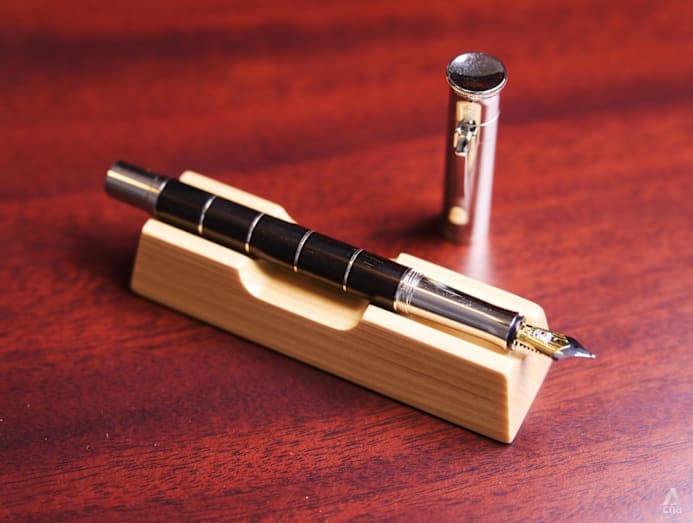 The Graf von Faber-Castell fountain pen from German pen manufacturer Faber-Castell. (Photo: CNA/Kelvin Chia)
“Imagine the weight of sterling silver in the grip section compared to the wood behind; the silver would be heavier,” he explained.
“You will feel that the pen is more front-weighted and that will help you write easier; it will guide the motion as you write,” he said, passing the pen to me to hold. “You can feel how the weight is balanced in your hand.”
He takes out another pen: A Pilot Custom Urushi Red Fountain Pen (Size 30 Nib) made of resin and plastic with a broader body.
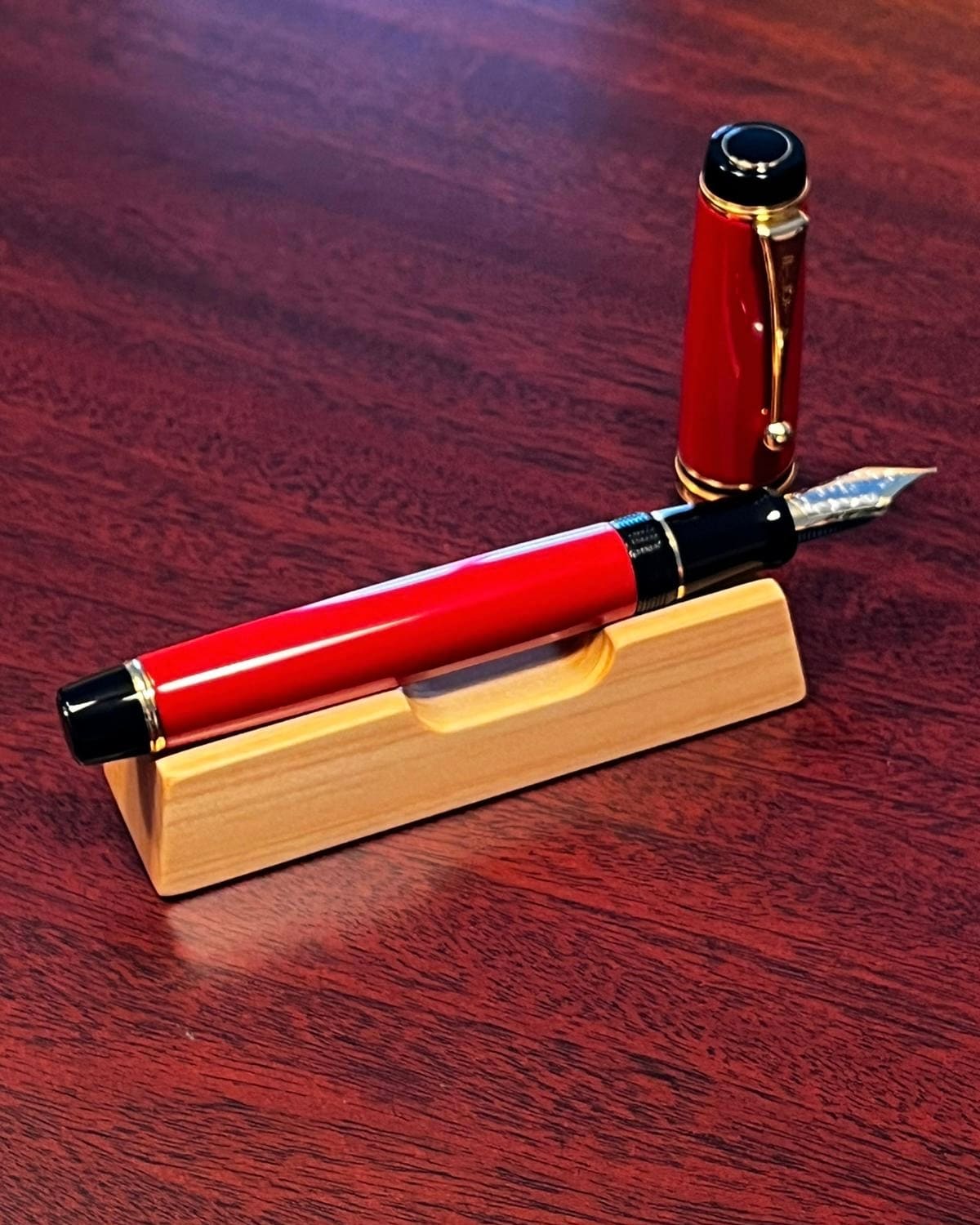 A Pilot Custom Urushi Red Fountain Pen (Size 30 Nib) made of resin and plastic. (Photo: Eugene Lee)
“The narrower the pen body, the more strain on your hand; because it’s smaller you're gripping it tighter. The larger the body, the easier it is to hold and write,” he said.
He shared how the writing sensation changes as well, depending on how fine the nib is ground down to, whether made out of a single sheet of gold, platinum or titanium. With a more flexible nib, the writing would feel “wet, smooth, buttery and soft”, but a pen with a less flexible nib would have “a little bit more feedback” and may “feel more scratchy”.
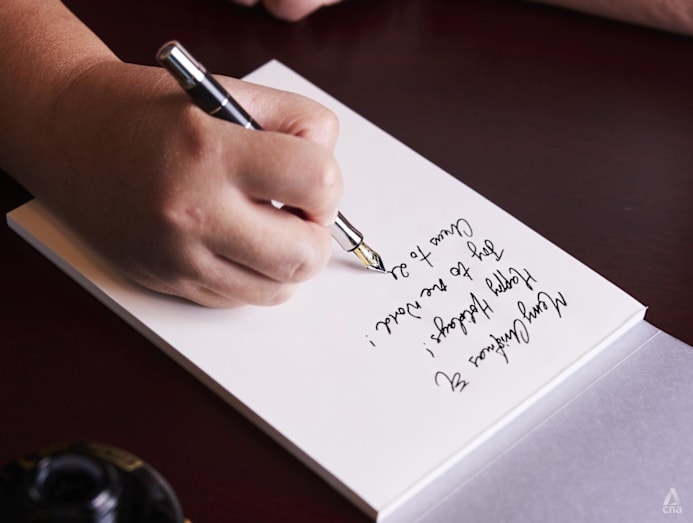 Lee writing with the Graf von Faber Castell fountain pen. (Photo: CNA/Kelvin Chia)
Such were the intricate yet unique details of the writing instrument that excited Lee.
“It really depends on the kind of sensation that you want,” he said. “Every pen has a different characteristic, every writer will have different preferences. It's a matter of matching the pen with the writer.
“What makes the writing experience? It's all these things put together.”
THE ELEVATED LOOK
Aesthetics also play a part. Pens with distinctive designs, especially those with special meaning, also attract Lee. Case in point: the Maki-e Zodiac pen series by Japanese brand Namiki, which happens to be one of the most expensive pieces in his collection.
He shared that he was drawn to the artwork on its barrel. “There's a tiger, horse, mouse and dragon; we only bought the animals that match our zodiac,” he said.
Due to the pens’ rarity, interested buyers need to be in the queue to get them. It could take between nine to 18 months from the time their local seller places an order till the time he gets the pen, Lee shared.
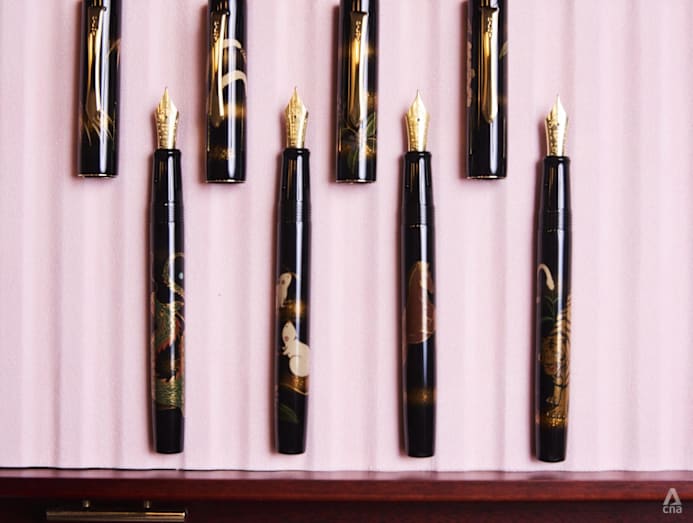 Four fountain pens from the Maki-e Zodiac pen series by Japanese brand Namiki, owned by Pilot. Each pen retails for S$3,633 on local pen store Aesthetic Bay’s website as of current. (Photo: CNA/Kelvin Chia)
Another stand-out pen set is the Shape of Heart series by Platinum.
Each one in the four-pen set features a dome top filled with crystals and two to four heart-shaped pieces punched out of its 14 Karat gold nib to make a breather hole, according to the Platinum website. While the heart-shaped pieces are usually melted down and reused to make more nibs, the collection incorporated them in the pen’s design – a striking detail that Lee noticed many other pen makers don’t have.
Unlike some collectors who prefer vintage items with a worn-in feel, Lee prefers them new – not old stock “brand new” pens in unopened boxes but new as of the day these were made.
He regularly turns to the social media pages of brands like Sailor and Platinum, and Japanese stationery shops like Nagasawa and Bungubox to find out about the latest releases.
LEE’S RARITIES
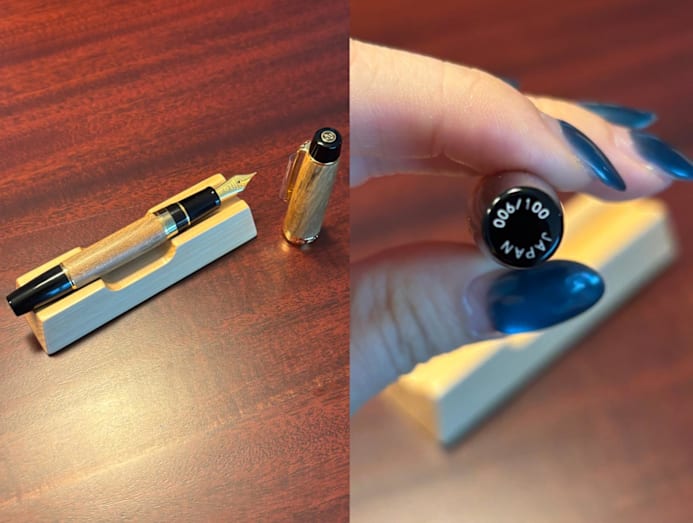 The 2022 Commemorative Fountain Pen for Rebuilding Sailor’s Hiroshima Factory in Taisanboku (Magnolia). Its back indicates it’s the sixth pen out of 100 in the world. (Photo: Charis Gan)
No collection is complete without prized rarities – and Lee’s is no exception. Among them are two 2022 commemorative fountain pens marking the rebuilding of Sailor’s Hiroshima factory.
Available in two colour variations, the rarer Taisanboku (Magnolia) was produced in just 100 pieces worldwide. According to Lee, two were ordered to Singapore – but only one arrived.
The other, Kaizuka Ibuki (Chinese Juniper), is limited to 500 pieces globally. As far as Lee knows, only one made it to Singapore.
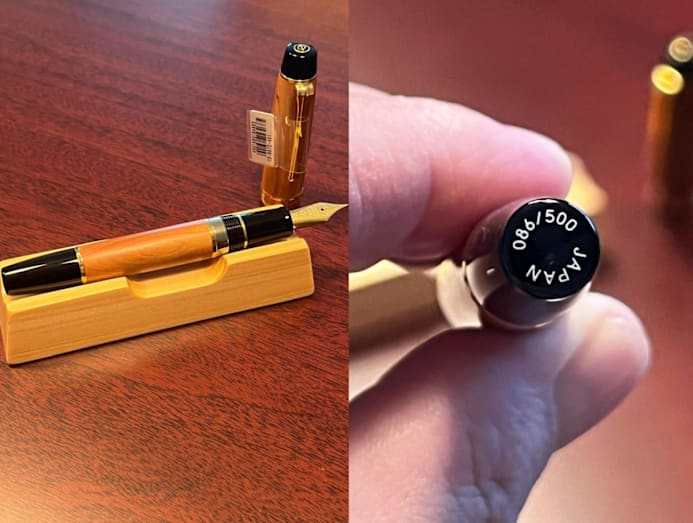 The 2022 Commemorative Fountain Pen for Rebuilding Sailor’s Hiroshima Factory in Kaizuka Ibuki (Chinese Juniper). Its back indicates it’s the 86th pen out of 500. (Photo: Eugene Lee)
“We went to a store in Singapore called Elephant & Coral and we saw the 500 piece one,” he shared.
“(The shop owner) said to me, ‘this is one of two (Hiroshima factory pens), you can't get the other one; it's too difficult – only 100 pieces sold worldwide, it probably never came to Singapore’,” Lee shared. “But it's in fact sitting in my tray.”
Another holy grail in Lee’s collection – one that’s not a fountain pen – is Platinum’s reproduction of the first mechanical pencil, the Hayakawa Mechanical Pencil, which his seller said was the only one brought to Singapore.
Originally invented and manufactured by electronics company Sharp, it’s modeled after the original pencil’s design created in 1915.
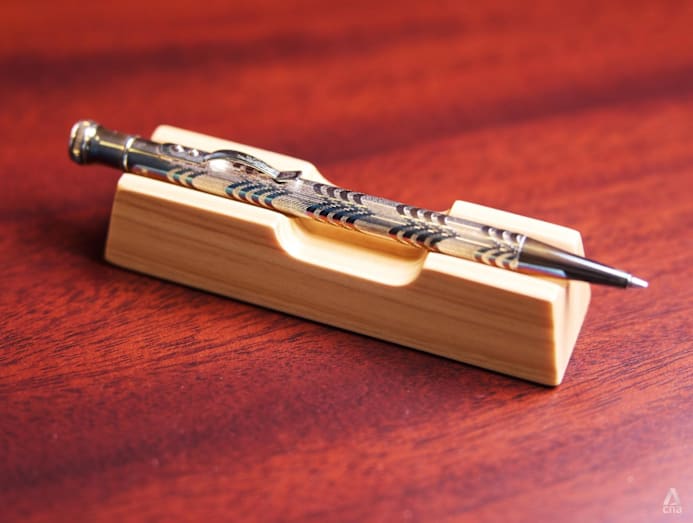 Platinum’s reproduction of the first mechanical pencil originally invented by electronics company Sharp. (Photo: CNA/Kelvin Chia)
With so many crown jewels, Lee said he’ll “probably never use” 90 per cent of the pens in his collection.
“Those that are very rare, we won't use,” he shared. “We won't use the Maki-E because it doesn't age very gracefully. This Hiroshima we won't use because I don't want my sweaty hands to spoil it!” he said with a laugh.
“But for the rest, it depends,” he said. For instance, if that year’s feng shui, a traditional Chinese practice centred on energy and spatial harmony, says that a certain color is fortuitous, they would pick a pen of that colour out of the collection, ink it and use it.
And if he does write with them, Lee also has a comprehensive collection of ink bottles. He and his wife even created a notebook full of ink swatches, which they refer to when refilling or dipping their pens.
Their inks vary in colour, glitter and scent – from coffee to lemon – and often come from their travels, including Taiwan. While his wife prefers experimenting with glittered inks, Lee sticks to the classic solid colours for notetaking purposes.
“Some of these inks are very wet and they’ll smudge over to the next page (in their ink swatch book) – I like to choose inks that are more sticky,” he said.
SHARING THE LOVE
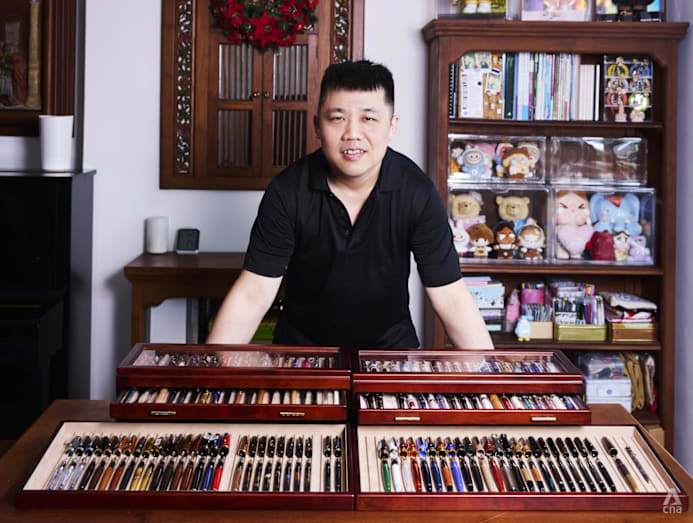 Semi-retired businessman Eugene Lee’s collection of fountain pens. (Photo: CNA/Kelvin Chia)
Ultimately, Lee prefers to keep the collection rather low-key; he doesn't share about it online nor with fellow enthusiasts.
But every so often, he and his wife would linger at their seller’s shop, mingling with fellow customers. And lately, they’ve begun to notice more new, young faces.
“There are actually quite a lot of young people (in their 20s) who are now trying to explore fountain pens,” he said.
“(The seller) told us they are usually first interested to buy the inks,” Lee explained. “And then you need a pen for all the inks. So they start to venture into very basic fountain pens first. After that, they start to grow into collectors like us.”
Lee often chats with them, sharing nuggets of fountain pen wisdom. “Usually it’s to get them down that rabbit hole. It’s always a comfort to know that other people are spending their money on these (pens),” he admitted with a laugh.
His advice to novice collectors? Instead of scrimping, “get the one that's more ‘worth it’. You should spend wisely. But spending less is not necessarily wise all the time.”
He elaborated: “My belief is that if you want to buy something, you buy to the best of what you can afford; don't overspend, buy within your means. But don't buy the S$20 pen when you can afford a S$200 pen.”
For example, Lee shared that if a pen shop is clearing old stock, one can get very good bargains for different fountain pens compared to what they are priced in the market.
As the couple does not have children, what will eventually happen to their collection is still up in the air.
“Maybe we’ll set up some trust or run a pen museum,” Lee joked.
But with the collection still growing and more gems waiting to be discovered, that might not be a bad idea at all.